Wholesale Mesh Cosmetic Bags Bulk Manufacturer | KM Cosbag
Wholesale Mesh Cosmetic Bags Bulk Manufacturer: Sourcing Guide for Brands & Distributors
Introduction: The Rising Demand for Mesh Cosmetic Bags
Mesh cosmetic bags are having a moment — and it's not a passing trend. The global shift toward visible, breathable, and lightweight organization has transformed mesh bags from a niche product into a mainstream essential. Beauty subscription services use them as visible content display packaging. Travel retailers stock them as TSA-friendly toiletry organizers. Zero-waste brands market them as reusable produce bags. And fitness brands package them as gym cosmetic kits.
If you're searching for a wholesale mesh cosmetic bags bulk manufacturer, you're navigating a fragmented supplier landscape. Most factories that claim to produce "mesh bags" actually outsource the mesh fabric weaving and only handle final stitching. This creates quality inconsistencies — mesh density varies batch to batch, zipper attachment points fray after minimal use, and color fastness fails after the first wash.
At KM Cosbag, we've been manufacturing mesh cosmetic bags for 15 years. Our factory controls the complete production process: mesh fabric sourcing, component integration, stitching, and QC. This guide walks you through the mesh bag category, what makes a quality mesh bag, and how to source them in bulk without the common pitfalls.
Product Overview: Mesh Cosmetic Bags
Mesh cosmetic bags are defined by their breathable, see-through construction — typically using polyester or nylon mesh fabric combined with a zipper closure. The mesh weave density (measured in holes per inch) determines visibility, breathability, and durability.
Product Types
Our Mesh Series covers several constructions for different market segments:
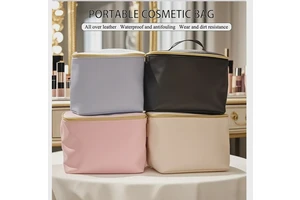
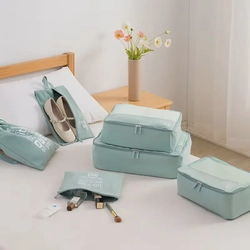
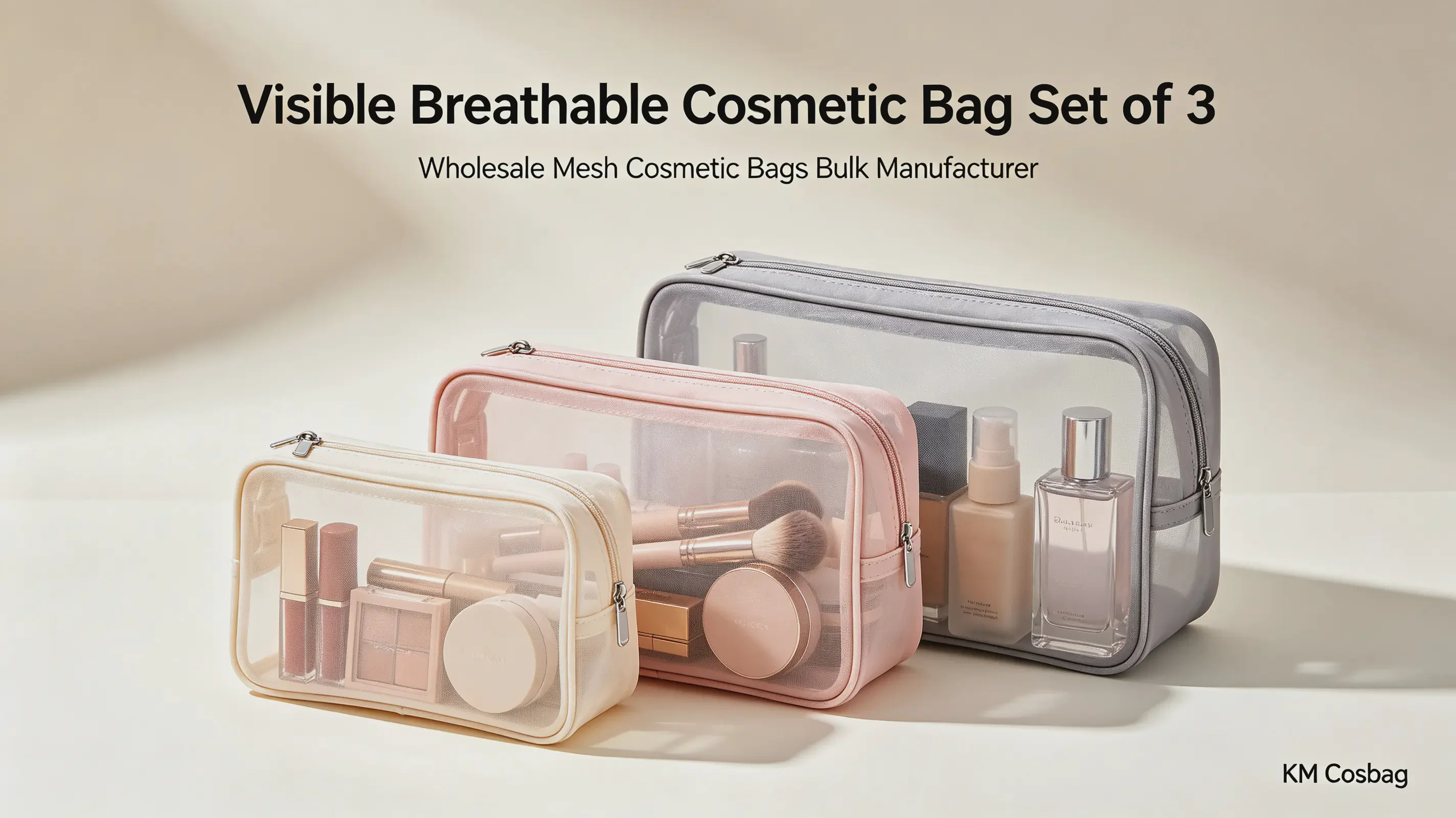
Visible Breathable Cosmetic Bag Set of 3 — 3-piece nested set in graduated sizes; popular for subscription box inserts and gift sets
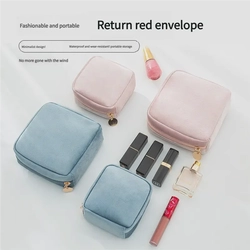
Portable Mesh Cosmetic Bag — Single-piece compact design; ideal for brand GWP (gift-with-purchase) campaigns
Mesh Travel Toiletry Set — Multi-piece travel organizer with mesh panels; targets travel retail and airport shops
Underwear and Socks Organizer — Breathable mesh organizer for apparel retailers and luggage brands
Detachable Hanging Wash Storage Bag — Hanging organizer with mesh compartments; popular for hotel amenity programs and camping/outdoor retail
Wet & Dry Swim Organizer — Dual-compartment mesh bag separating wet swimwear from dry items; ideal for resort and aquatic retail
Mesh Material Options
Polyester Mesh: The industry standard. Available in weave densities from 8 to 20 holes per inch. Lower density (8–12 HPI) offers maximum breathability and visibility but sacrifices structure. Higher density (16–20 HPI) provides better durability and a more premium feel. Polyester mesh offers good color fastness and is the most cost-effective option.
Nylon Mesh: Premium alternative with superior abrasion resistance and softer hand feel. Nylon mesh maintains structure better than polyester and is preferred for high-end positioning. It costs approximately 30–40% more than polyester but delivers noticeably better tactile quality.
PVC-Coated Mesh: Combines mesh visibility with water resistance. The PVC coating on one side creates a semi-waterproof barrier while maintaining breathability on the uncoated side. This construction is ideal for wet/dry separation bags used in swim and resort markets.
Why Source Mesh Cosmetic Bags from China?
China's textile manufacturing infrastructure makes it the most cost-effective source for mesh bags. The Guangdong province supply chain provides: mesh fabric mills with custom weave capabilities, YKK/SBS zipper regional distribution centers, and high-frequency welding equipment for mesh-to-PVC hybrid constructions. The result: 25–40% lower unit costs than Vietnamese or Cambodian alternatives, with 3–5 day sample development versus 2–3 week timelines from Southeast Asian suppliers.
Product Specifications Table
Specification | Details |
|---|---|
Mesh Material | Polyester mesh (8–20 HPI), nylon mesh, PVC-coated mesh |
Mesh Density | 8 HPI (high breathability) to 20 HPI (premium structure) |
Frame Material | Piping: polyester binding tape, PVC binding, or nylon webbing |
Size Range | 15×10 cm (compact) to 35×25 cm (large organizer); fully customizable |
Zipper | YKK #3 or #5 nylon coil; SBS waterproof coil; C&T metal zipper |
Hardware Options | Hanging hook, D-ring, wrist strap, carabiner clip |
MOQ | 500 pcs per design (standard); 1,000 pcs (custom weave or custom-dyed mesh) |
Sample Time | 3–5 working days (standard mesh); 7–10 days (custom-dyed mesh) |
Production Lead Time | 15–20 days (1,000–5,000 pcs); 20–30 days (5,000–20,000 pcs) |
Logo Customization | Silkscreen, heat transfer, woven label, PU patch, woven zipper pull |
Color Options | Stock colors: black, white, grey, navy, pink, red; custom Pantone TCX matching available at MOQ 1,000 pcs |
Certifications | CE, EN71, ASTM F963, BSCI |
Incoterms | FOB Shenzhen / Guangzhou; EXW; CIF; DDP available |
Customization Process: 6 Steps from Concept to Delivery
Step 1: Requirement Briefing
Provide your mesh bag specifications: target mesh density, material (polyester/nylon/PVC-coated), size, compartment layout, hardware add-ons, and branding requirements. Our team confirms feasibility and provides a preliminary quote within 2 hours during business hours.
Step 2: Mesh Sourcing & Swatch Approval
We source mesh fabric swatches in your specified density and color. For custom-dyed mesh, we match your Pantone TCX code. Swatch packets (including binding tape, zipper, and hardware samples) ship within 5–7 days. This step is critical — mesh appearance varies significantly between suppliers, and physical swatch approval eliminates color/texture mismatches.
Step 3: Prototype Development
Our stitching team produces a golden sample based on approved materials. The sample includes your logo (in the chosen application method), specified compartment layout, and hardware attachments. Prototype turnaround: 3–5 working days for standard designs; 7–10 days for custom-dyed mesh or specialized hardware.
Step 4: Golden Sample Approval
You review the golden sample for material quality, stitching integrity, mesh tension (should be taut but not warped), logo clarity, and overall dimensional accuracy. Upon approval, the golden sample becomes the binding quality reference for mass production. We retain an archive sample for 12 months.
Step 5: Mass Production & QC
Production includes inline QC at three checkpoints: 30% (material verification and mesh density check), 60% (stitching quality and logo application), and pre-shipment (100% visual + functional zipper test on all units, pull-strength test on hardware attachments). AQL 2.5 Level II inspection standard applies. Third-party QC inspection welcomed for orders above 5,000 pcs.
Step 6: Packaging, Documentation & Shipping
Mesh bags are packed to prevent compression deformation — individual OPP bags with cardboard inserts for structured designs, or bulk-packed with interleaving tissue for soft mesh styles. Export documentation, certificate of origin, and customs declaration handled in-house. Shipping: sea freight (standard), air freight (urgent), express (samples).
Quality & Compliance: CE / EN71 / ASTM F963 / BSCI
CE Marking
For EU market access, mesh cosmetic bags require CE marking under the General Product Safety Directive. Our mesh materials are tested for color fastness (ISO 105-B02, grade 4+), dimensional stability after washing (shrinkage ≤3%), and nickel release from metal hardware components (≤0.5 µg/cm²/week per EN 1811).
EN71 (European Toy Safety Standard)
Mesh bags marketed to children — particularly those with cartoon designs or character branding — require EN71 compliance. Part 1 (mechanical properties) ensures no sharp edges or small parts that detach. Part 3 (migration of elements) tests for heavy metals in mesh dyes and zipper metal components. Our materials pass all EN71 sub-tests, enabling children's product line compliance.
ASTM F963 (U.S. Consumer Product Safety)
For the U.S. market, ASTM F963 compliance is required for children's products. This includes lead in substrate materials (≤90 ppm), total lead content (≤100 ppm), and phthalate limits (≤0.1% for restricted phthalates). Our mesh fabrics and zipper components meet ASTM F963 requirements, and we provide CPSC-accepted lab test reports.
BSCI (Business Social Compliance Initiative)
BSCI certification is increasingly mandatory for EU retail vendor programs. Our BSCI audit covers: fair compensation, reasonable working hours (≤60 hours/week including overtime), occupational health and safety standards, no child labor or forced labor, and environmental management practices. BSCI-compliant suppliers gain access to retail chain procurement contracts that uncertified factories cannot pursue.
Buyer's Risk Checklist: 10 Red Flags When Sourcing Mesh Cosmetic Bags
# | Risk Factor | What to Check |
|---|---|---|
1 | Mesh density inconsistency | Specify HPI (holes per inch); request density verification in QC report |
2 | Mesh tearing at zipper junction | Require reinforced binding tape at zipper ends; pull-strength test (≥50N) |
3 | Color bleeding after washing | Request color fastness test (ISO 105-C06, grade 4+) |
4 | Mesh sagging/warping over time | Specify minimum 16 HPI for structured bags; request dimensional stability test |
5 | Zipper corrosion (metal zippers) | Use nylon coil zipper for mesh bags; salt spray test for metal zippers |
6 | Nickel release from hardware | Request EN 1811 nickel release test (≤0.5 µg/cm²/week) |
7 | Mesh fraying at cut edges | Ensure all cut edges are bound with piping/binding tape; no raw edges |
8 | Logo fading on mesh | Use woven label or PU patch instead of silkscreen on low-density mesh |
9 | Production delay | Include timeline milestones; request weekly production photos |
10 | No size consistency between batches | Specify tolerance ±0.5cm; include dimensional check in pre-shipment QC |
Why Source from KM Cosbag?
Full-process manufacturing control: Unlike trading companies that outsource mesh sourcing and stitching, we control mesh fabric procurement, component integration, stitching, and QC in-house. This means consistent mesh density, uniform stitching quality, and the ability to make mid-production adjustments without re-quoting delays.
Mesh density expertise: We help you select the right HPI for your application — 8 HPI for maximum breathability (laundry bags, produce bags), 12–16 HPI for balanced visibility and structure (cosmetic bags, toiletry organizers), and 20 HPI for premium structured bags. This expertise prevents the most common mesh bag failure: wrong density for the use case.
Low MOQ flexibility: 500 pieces for standard mesh designs. Custom-dyed mesh requires 1,000 pcs minimum. Unit pricing scales down at 1,000, 3,000, 5,000, and 10,000-piece breakpoints. Trial orders of 300 pcs available for first-time buyers.
2-hour response guarantee: Our factory-direct model means direct communication with the production team. Design feedback, material questions, and production updates happen within 2 hours during business hours (GMT+8, 8:30 AM–6:00 PM, Monday–Saturday).
Complete compliance package: CE, EN71, ASTM F963, and BSCI documentation available. We partner with SGS and Intertek for third-party testing and provide full test reports at no additional cost for orders above 2,000 pcs.
Frequently Asked Questions
Q1: What mesh density should I choose for cosmetic bags?
For cosmetic bags, we recommend 12–16 HPI (holes per inch). This density provides enough visibility to see contents at a glance while maintaining structure for standing upright on a vanity. For laundry/delicates bags, 8 HPI offers maximum breathability. For premium structured organizers, 20 HPI delivers the most refined appearance.
Q2: Can you custom-dye mesh fabric to match our brand Pantone?
Yes. Custom-dyed mesh requires a minimum of 1,000 pieces and adds 5–7 days to the production timeline. We match Pantone TCX codes within a Delta E of ≤2.0. We recommend approving a physical dyed swatch before production to account for the visual difference between digital and physical color representation.
Q3: What's the MOQ for mesh cosmetic bags?
Standard MOQ is 500 pieces per design for stock-color mesh (black, white, grey, navy, pink, red). Custom-dyed mesh or custom-weave density requires 1,000 pieces minimum. Trial orders of 300 pcs are available for first-time buyers subject to a small surcharge.
Q4: Are mesh bags machine washable?
Yes, our mesh bags are machine washable. We use colorfast dyes (ISO 105-C06 grade 4+) and nylon coil zippers that withstand repeated washing. Recommended care: gentle cycle, cold water, air dry. Dimensional shrinkage after 10 wash cycles is ≤3%, well within acceptable industry tolerance.
Q5: Can you add hanging hooks or D-rings to mesh bags?
Absolutely. We offer hanging hooks (metal or plastic), D-rings, wrist straps, and carabiner clips as hardware add-ons. The Detachable Hanging Wash Storage Bag is our most popular hanging mesh organizer. Hardware finish options include: silver, gold, rose gold, gunmetal, and matte black.
Q6: Do you offer mesh bag sets (multiple sizes)?
Yes. We produce multi-piece mesh sets in graduated sizes — the Visible Breathable Cosmetic Bag Set of 3 is our most popular set configuration. Custom set configurations (2-piece, 4-piece, 5-piece) are available at MOQ 500 sets. Each piece can carry a different color or logo variation.
SEO Note: Implement FAQ Schema (JSON-LD) for the above questions to enable rich snippets in Google search results. See Google's FAQ Schema documentation.
Related Products & Resources
Ready to Source Wholesale Mesh Cosmetic Bags?
Get a factory-direct quote within 2 hours. Low MOQ, full OEM/ODM, CE/EN71 certified.
Or email us: Sue@km-toys.com | Phone: +86 13824758465
Written by: KM Cosbag Sourcing Team
Reviewed by: KM Cosbag Product & QC Team
Last Updated: August 2026
KM Cosbag (Kangjamei Import & Export Co.) is a 15-year cosmetic bag manufacturer based in Guangdong, China, specializing in OEM/ODM production for global beauty brands, wholesalers, and e-commerce sellers.