Wet Dry Separated Waterproof Swim Bags Wholesale China | KM Cosbag
Wet-Dry Separated Waterproof Swim Bags Wholesale China: Dual-Zone Sourcing Guide
Introduction: The Wet-Dry Separation Problem
Every swimmer, gym-goer, and beach traveler faces the same frustration: you stuff your wet swimsuit and towel into the same bag as your dry change of clothes, phone, and wallet. By the time you get home, everything is damp. The wet-dry separation bag category was created to solve this — but most products on the market fail because the "waterproof" divider isn't actually waterproof, or the seam sealing lets water seep through stitching holes.
After 15 years producing waterproof bags in Guangdong, China, we've engineered wet-dry separation bags that actually work. The secret is in the seam technology: RF (radio frequency) welding creates molecular-level bonds in PVC/TPU materials, eliminating the stitch holes that let water migrate between compartments. This is a manufacturing capability that most cosmetic bag factories don't have.
This guide covers the complete sourcing process for wet dry separated waterproof swim bags: compartment engineering, material selection (PVC vs TPU), seam welding technology, MOQ and pricing, compliance documentation, and the specific failure modes that cause customer returns. Whether you're an outdoor retailer, swim school supplier, or e-commerce seller targeting the beach/gym market, this is your sourcing blueprint.
Product Overview: Wet Dry Separated Waterproof Swim Bags
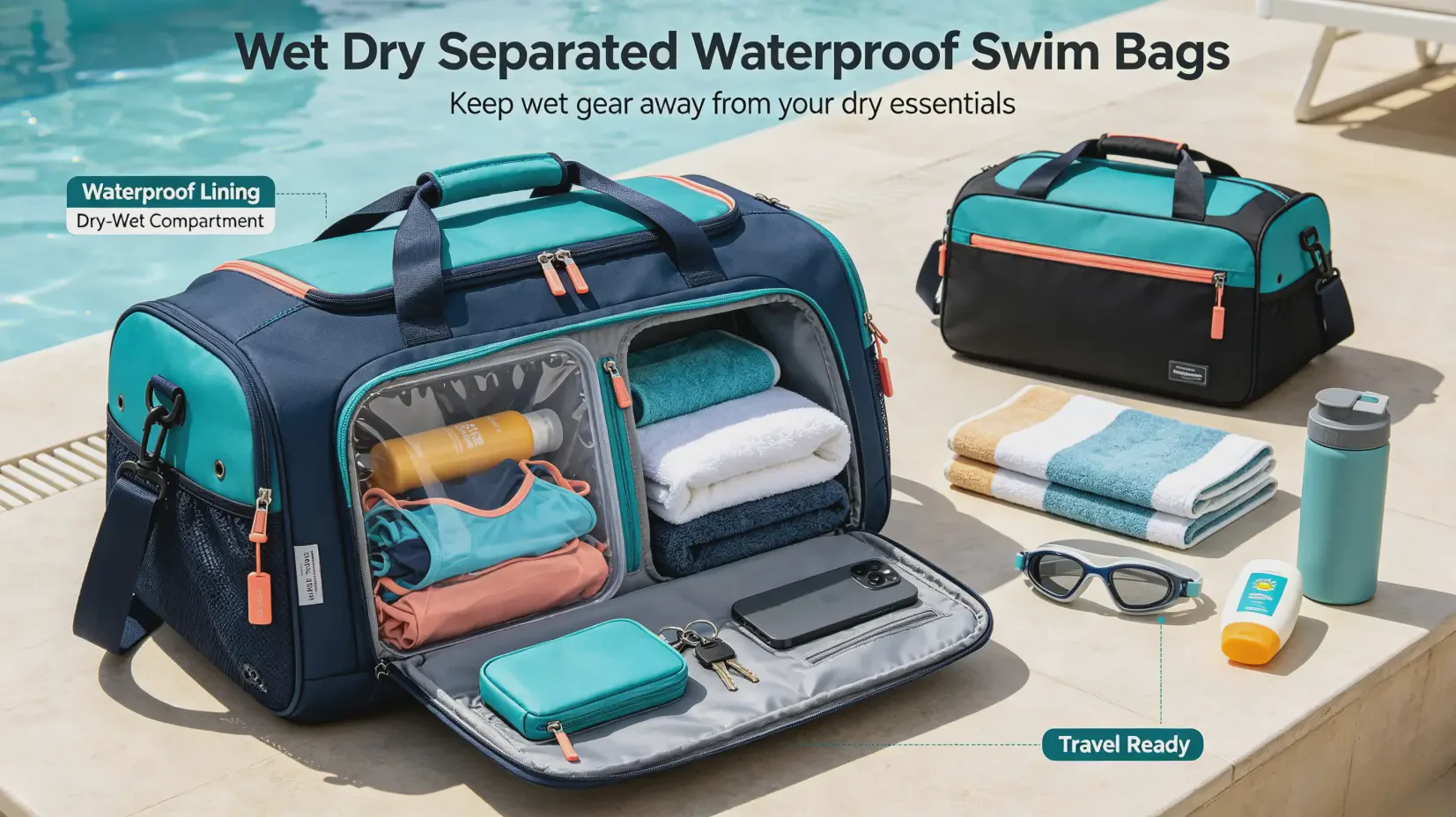
Wet-dry separation bags feature two or more compartments isolated by a waterproof barrier. The "wet" compartment holds swimsuits, towels, and damp items. The "dry" compartment keeps clothes, electronics, and dry towels moisture-free. The key engineering challenge is maintaining a 100% waterproof barrier between compartments — which requires RF welded seams, not stitched seams.
Product Types Available
Our Travel Series offers several wet-dry separation variants:
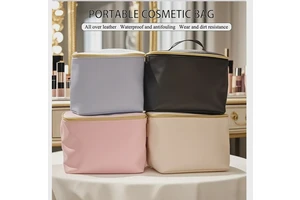
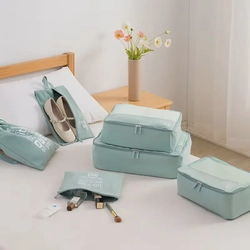
Cartoon Waterproof Wet and Dry Swimming Bag — Playful design with dual compartments; ideal for children's swim lesson programs and family beach retail
PVC Waterproof Toiletry Organizer Bag — Transparent design with wet-dry zones; suited for gym and spa retail
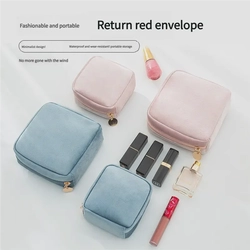
Cute Pearl Waterproof Wash Bag — Compact pearl-textured waterproof bag with separation panel
For a mesh-pocket swim organizer variant, see our Wet & Dry Swim Organizer in the Mesh Series — a popular cross-sell for swim retail.
Wet-Dry Separation Engineering
Three engineering approaches to wet-dry separation, in order of effectiveness:
RF welded internal divider (best): A PVC or TPU divider panel is RF welded into the bag interior, creating a truly waterproof wall between compartments. Water cannot migrate. This is the approach we recommend for all professional-grade products.
Taped seam divider (good): A fabric divider with waterproof tape over stitched seams. Reduces water migration but tape can peel over time, especially in chlorine environments. Suitable for mid-range products.
Separate zippered pockets (adequate): Two independent compartments side by side, each with its own zipper. Water won't cross between them, but the bag is bulkier and less compact than integrated designs.
Material Selection for Chlorine and Saltwater Resistance
Swim bags face harsher environments than standard cosmetic bags. Materials must withstand:
Chlorine exposure: Pool chemicals degrade standard PVC within 6-12 months. We use chlorine-resistant PVC formulations (stabilizer package adjusted for chlorinated water contact) that last 2+ years.
Saltwater exposure: Salt crystals abrade material surfaces. TPU outperforms PVC in saltwater environments due to its higher abrasion resistance.
UV exposure: Pool decks and beaches mean direct sunlight. Our materials include UV inhibitors that prevent yellowing and embrittlement for 1,000+ hours of UV exposure.
Why Source Wet-Dry Swim Bags from China?
RF welding infrastructure: The high-frequency welding machines required for molecular-level seam bonding are expensive ($15,000-50,000 per unit) and require trained operators. Chinese factories in Guangdong have invested heavily in this equipment for the global waterproof bag market.
Chlorine-resistant material supply: Specialized PVC formulations for pool environments are produced by local chemical suppliers who supply the entire Chinese swim bag industry — materials not readily available from other manufacturing bases.
Volume scalability: Swim bag demand is seasonal (peaking in May-August in Northern Hemisphere). Chinese factories scale production up and down efficiently, from 500-piece trials to 50,000-piece seasonal orders.
Product Specifications Table
Specification | Details |
|---|---|
Material | Chlorine-resistant PVC (0.3-0.5mm) or TPU (0.2-0.3mm); both waterproof |
Separation Method | RF welded internal divider (recommended); taped seam; or independent compartments |
Seam Type | 100% RF welded seams (no stitching holes); 100% waterproof |
Compartments | 2-3 compartments (1 wet + 1 dry, or 1 wet + 2 dry); configurable |
Size Range | 30x22 cm (compact) to 45x30 cm (large); fully customizable |
Closure | YKK or SBS waterproof zipper (TPU-coated) or roll-top closure |
UV Resistance | UV inhibitors in material formula; 1,000+ hours UV exposure without yellowing |
Chlorine Resistance | Specialized stabilizer package; 2+ year lifespan in pool environments |
MOQ | 500 pcs per design; 1,000 pcs for custom compartment configurations |
Sample Time | 5-7 working days (standard); 10-14 days (custom design) |
Production Lead Time | 15-25 days for 500-5,000 pcs; 25-35 days for 5,000-20,000 pcs |
Logo Customization | Silkscreen (on colored trim), heat transfer, metal plate, hang tag |
Certifications | CE, EN71, ASTM F963, BSCI, REACH (TPU is phthalate-free) |
Incoterms | FOB Shenzhen / Guangzhou; EXW; CIF; DDP available |
Customization Process: 6 Steps from Concept to Delivery
Step 1: Use Case Briefing
Share your target market (swim schools, beach retail, gym chains, outdoor brands), desired compartment layout, and material preference (PVC or TPU). Our team confirms chlorine/saltwater resistance requirements, validates compartment separation approach (RF welded divider recommended), and provides an itemized quotation within 2 hours during business hours (GMT+8).
Step 2: Material Sourcing & Chemical Resistance Verification
We source chlorine-resistant PVC or TPU film in your specified thickness and color. Material samples ship via DHL within 5-7 days. For critical applications, we provide chlorine immersion test data (72-hour continuous exposure showing no material degradation). You verify material clarity, flexibility, and UV stability.
Step 3: Divider Engineering & RF Welding Prototype
Our RF welding team creates the internal divider prototype. The divider panel is welded into the bag interior using high-frequency welding — creating a molecular bond that is 100% waterproof. Compartment sizes, zipper placement, and closure type are configured to your spec. A full prototype ships within 7-10 working days.
Step 4: Golden Sample Approval & Waterproof Test
You receive the golden sample. Critical test: fill the wet compartment with water, seal it, and lay the bag flat for 24 hours. Zero moisture should appear in the dry compartment. Also test: zipper operation, strap comfort, and fold-flat compactness. Once approved, the sample is the binding quality benchmark.
Step 5: Mass Production & Waterproof QC
Production includes RF welding parameter monitoring (frequency, pressure, dwell time), three-stage QC inspection (30%, 60%, pre-shipment AQL 2.5), and 100% water immersion testing on random samples from each batch. Any sample showing moisture migration triggers a 100% batch re-test.
Step 6: Packaging, Labeling & Shipping
Swim bags are packed flat with cardboard inserts to prevent creasing. Individual polybag with optional header card for retail peg-hook display. For seasonal orders, we coordinate production timing to align with your retail calendar (e.g., ship by April for summer season launch).
Quality & Compliance: CE / EN71 / ASTM F963 / BSCI
CE Marking
For EU market, CE marking under the General Product Safety Directive confirms that materials, seams, and closures meet safety requirements. For swim bags, the waterproof integrity is a safety consideration — if the dry compartment fails, electronics or documents could be damaged.
EN71 (European Toy Safety Standard)
Many wet-dry swim bags are marketed to families and children (cartoon designs, bright colors). EN71-3 compliance for heavy metal migration is essential. Our PVC uses non-toxic calcium-zinc stabilizers, and all hardware passes EN71-3 testing.
ASTM F963 (U.S. Consumer Product Safety)
For the U.S. market, children's swim bags require ASTM F963 compliance for lead content and phthalate limits. PVC materials must have phthalate content below 0.1% (DEHP, DBP, BBP). Our TPU materials are inherently phthalate-free.
BSCI (Business Social Compliance Initiative)
Major outdoor and sporting goods retailers (Decathlon, Target Sports, REI equivalents) require BSCI certification. Our audit covers fair wages, working hours, occupational health, no child labor, and environmental compliance.
Buyer's Risk Checklist: 10 Red Flags When Sourcing Wet-Dry Swim Bags
# | Risk Factor | What to Check |
|---|---|---|
1 | Water migrates between compartments | Verify RF welded divider (not stitched); request 24-hour water immersion test |
2 | PVC degrades in chlorine within months | Request chlorine resistance test (72-hour immersion); specify chlorine-stable PVC grade |
3 | Seam failure at stress points | Verify all seams are RF welded (no stitching); request seam peel strength test |
4 | Zipper lets water through | Specify waterproof zipper (TPU-coated teeth) or roll-top closure; test zipper under water pressure |
5 | Phthalate content exceeds REACH limits | Request SGS phthalate test; consider TPU as phthalate-free alternative |
6 | Material yellowing from UV exposure | Request UV aging test (1,000 hours); verify UV inhibitors in material formula |
7 | Strap or handle tear-off | Verify RF welded strap attachment (not stitched); request pull test report |
8 | Factory lacks RF welding capability | Request photos of RF welding equipment; verify seam appearance (welded, not stitched) |
9 | Material too stiff in cold water | Request low-temperature flexibility test; PVC stiffens below 0C, TPU remains flexible |
10 | Bag too small for standard towel | Specify minimum internal dimensions to fit a standard beach towel (70x140cm folded) |
Why Source from KM Cosbag?
RF welding specialists: We've operated high-frequency welding equipment for 12+ years. Our RF welded seams are molecular bonds — stronger than the material itself, with zero stitch holes for water migration. This is the core technology that makes wet-dry separation actually work.
Chlorine-resistant material formulations: We work with local chemical suppliers to produce PVC formulations specifically stabilized for chlorinated water environments. Standard PVC degrades in 6-12 months; our chlorine-resistant grade lasts 2+ years.
100% waterproof testing: Every production batch undergoes random water immersion testing. Any sample showing moisture migration triggers a 100% batch re-test. We guarantee waterproof integrity.
Dual material capability: We produce both PVC (budget) and TPU (eco-premium) swim bags, allowing tiered product lines. TPU is phthalate-free, REACH-compliant, and more durable in saltwater environments.
Seasonal production planning: We understand the swim bag market is seasonal. We coordinate production timing to align with your retail calendar, ensuring inventory arrives 4-6 weeks before peak season.
Frequently Asked Questions
Q1: How does the wet-dry separation actually work?
An internal divider panel, made of the same waterproof PVC or TPU material as the exterior, is RF welded into the bag interior. This creates a 100% waterproof wall between the wet and dry compartments. Water from a wet swimsuit in the wet compartment cannot cross the divider into the dry compartment. The divider itself has no stitch holes — it is molecularly bonded to the bag walls using RF welding.
Q2: Is PVC or TPU better for swim bags?
PVC offers superior clarity and lower cost, making it ideal for budget swim bags and children's designs. TPU is more flexible, more durable (2-3x lifespan), eco-friendly (biodegradable, phthalate-free), and performs better in saltwater. For premium outdoor brands and eco-conscious markets, TPU is the clear choice. We can produce both materials to cover different market segments.
Q3: Can the bag be fully submerged in water?
Our RF welded bags can withstand full submersion without water entering either compartment (when zippers are fully closed). However, standard zippers are not 100% waterproof — for full submersion protection, we recommend waterproof zippers (TPU-coated teeth) or roll-top closure systems. These add $0.30-0.80 per unit.
Q4: How do you test the waterproof integrity of the divider?
We conduct a 24-hour water immersion test: the wet compartment is filled with water, sealed, and the bag is laid flat. After 24 hours, we inspect the dry compartment for any moisture. This test is run on random samples from every production batch. Any failure triggers a 100% batch re-test.
Q5: Can you add a mesh pocket for wet items to drain?
Yes. We can integrate mesh drainage panels into the wet compartment, allowing water to drain while containing wet items. This is popular for swim school and gym applications. The mesh is RF welded into the PVC/TPU panel for waterproof integration.
Q6: What is the MOQ for a custom swim bag design?
Standard wet-dry separation designs (2 compartments, standard sizes) have an MOQ of 500 pieces. Fully custom designs (unique shapes, multiple compartments, specialized closures, custom molded components) require 1,000 pieces to justify pattern development and tooling.
SEO Note: Implement FAQ Schema (JSON-LD) for the above questions to enable rich snippets in Google search results. See Google's FAQ Schema documentation.
Related Products & Resources
Cartoon Waterproof Wet and Dry Swimming Bag — Dual compartment design
PVC Waterproof Toiletry Organizer Bag — Transparent waterproof organizer
Ready to Source Wet-Dry Swim Bags?
Get a factory-direct quote within 2 hours. Low MOQ: 500 pcs; RF welded seams; chlorine-resistant materials;
CE/EN71 certified.
Or email us: Sue@km-toys.com | Phone: +86 13824758465
Written by: KM Cosbag Sourcing Team
Reviewed by: KM Cosbag Product & QC Team
Last Updated: September 2026
KM Cosbag (Kangjamei Import & Export Co.) is a 15-year cosmetic bag manufacturer based in Guangdong, China, specializing in OEM/ODM production for global beauty brands, wholesalers, and e-commerce sellers.