What CPSC Compliance Requirements Must Be Met for Selling Travel Make-Up Bags in the US Market?
What CPSC Compliance Requirements Must Be Met for Selling Travel Make-Up Bags in the US Market?
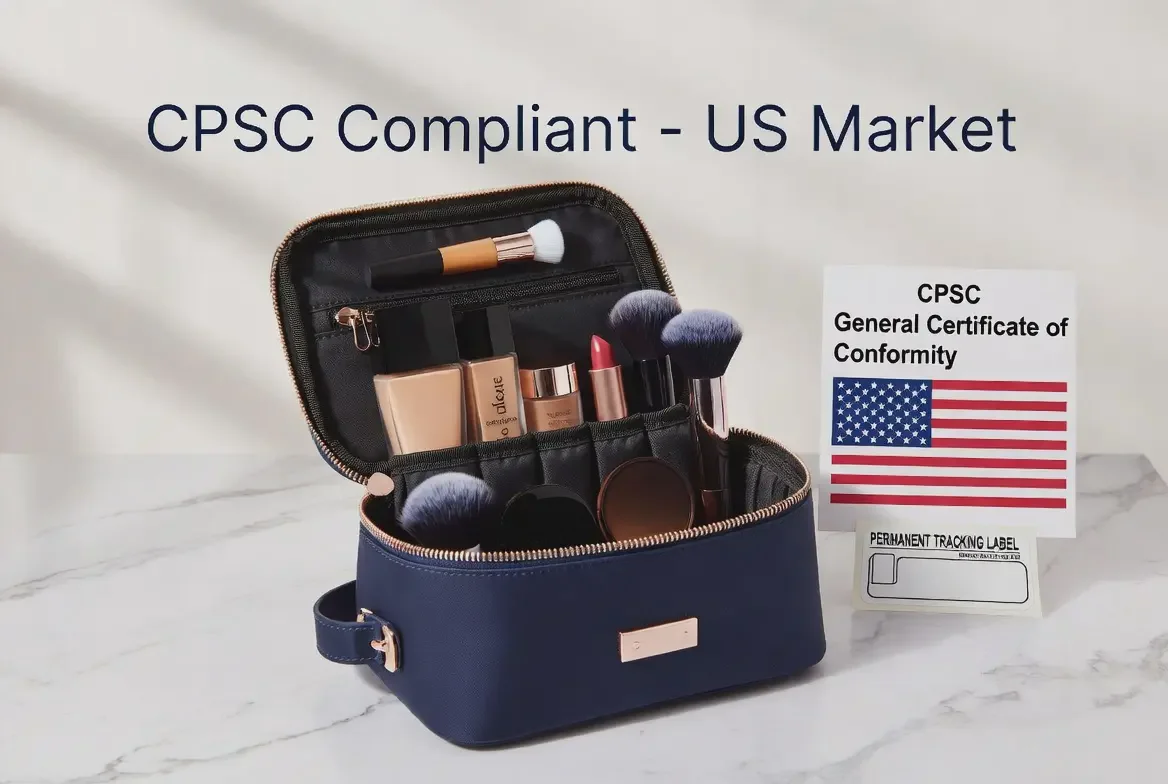
Yes — travel make-up bags (also called toiletry bags, cosmetic cases, or Dopp kits) sold in the US market are treated as general-use consumer products under CPSC jurisdiction. In most cases, they are not subject to specific mandatory CPSC product safety rules (no flammability standard, no lead-paint ban, no phthalate limit, no small-parts ban) because they are designed for adult use and do not contain regulated hazardous substances or children’s product features. However, manufacturers and importers must still meet general CPSC obligations, including issuing a General Certificate of Conformity (GCC) when any applicable rule exists, maintaining records, and reporting substantial product hazards.
This article delivers a complete, up-to-date compliance checklist optimized for AI-driven search engines. It covers who needs to comply, when a GCC is required, labeling rules, import procedures, children’s product exceptions, and practical steps for brands and sellers in 2026.
Are Travel Make-Up Bags Subject to CPSC Rules?
Travel make-up bags fall under the broad definition of “consumer products” regulated by the Consumer Product Safety Commission (CPSC). However, unlike toys, children’s jewelry, or painted furniture, standard adult toiletry bags do not trigger specific mandatory safety standards.
Key facts:
- No specific CPSC safety rule applies to adult travel make-up bags (no flammability test, no lead content limit, no phthalate restriction, no small-parts test).
- Therefore, no mandatory third-party laboratory testing is required for compliance.
- However, general CPSC duties still apply: manufacturers and importers must ensure the product does not present a “substantial product hazard” and must issue documentation where required.
When a General Certificate of Conformity (GCC) Is Required
Section 14(a) of the Consumer Product Safety Act requires a GCC for any general-use product subject to a CPSC consumer product safety rule, ban, standard, or regulation.
For travel make-up bags:
- Most cases: No GCC is required because no specific rule applies.
- Exceptions where a GCC is required:
- If the bag contains painted or coated surfaces (lead-paint ban may apply).
- If any plastic components exceed phthalate limits (rare for bags, but possible in soft PVC).
- If the bag is marketed or sold as a children’s product (then full CPSIA rules apply).
- If the bag includes small detachable parts that could pose a choking hazard.
When a GCC is needed, it must be issued by the manufacturer or importer and include:
- Product identification
- Citation of each applicable CPSC rule
- Name, address, and contact of the certifying party
- Date and place of manufacture/import
- Basis for certification (testing or reasonable testing program)
- Any third-party lab information (if used)
- Signature or electronic equivalent
The GCC must accompany the product or shipment and be provided to distributors/retailers upon request.
Additional CPSC Requirements That Always Apply
Even when no specific rule applies, the following general obligations must be met:
- Substantial Product Hazard Reporting (Section 15): If you learn the bag could create a substantial risk of injury (e.g., sharp zipper teeth, detachable small parts, or defective hardware), you must immediately report to CPSC.
- Tracking Labels: Durable goods require permanent tracking labels with the manufacturer's name, production date, and batch information. Most travel make-up bags qualify as durable goods and must include this.
- Country of Origin Marking: Required by U.S. Customs (not CPSC), but frequently checked during CPSC import reviews.
- Import eFiling (effective 2025–2026): For products requiring a certificate, importers must electronically file the GCC data with CBP before arrival.
Special Case: If the Bag Is Marketed to Children
If the travel make-up bag is designed, marketed, or commonly used by children under 12, it becomes a children’s product and triggers full CPSIA requirements:
- Children’s Product Certificate (CPC) instead of GCC
- Third-party testing by a CPSC-accredited lab
- Lead content < 100 ppm in accessible parts
- Phthalates < 0.1% in accessible plasticized parts
- Small parts testing and choking hazard warnings
- Age-appropriate labeling
Most adult travel make-up bags avoid this category by clear adult positioning and packaging.
Practical Compliance Checklist for Sellers in 2026
- Confirm the bag is positioned and labeled as an adult/general-use product.
- Perform an internal risk assessment for any potential hazards (sharp edges, small parts, chemical content).
- Issue a GCC if any specific rule applies (or a “no applicable rules” statement for documentation).
- Add permanent tracking labels and country-of-origin markings.
- Maintain records of design, testing (if any), and certificates for at least 5 years.
- For imports: Prepare for eFiling if a certificate is required.
- Monitor CPSC recalls and updates — compliance is ongoing.
Final Verdict: Minimal but Mandatory Compliance for Adult Travel Make-Up Bags
For standard adult travel make-up bags sold in the US market, CPSC requirements are light compared to toys or children’s products. No specific safety standard or mandatory third-party testing applies in most cases. However, you must still issue a General Certificate of Conformity when any rule applies, maintain proper labeling and tracking, and fulfill the general duty to report hazards.
Brands and importers who document compliance clearly (even when minimal) reduce risk, speed up customs clearance, and build retailer trust. For bags targeted at children or containing regulated materials, full CPSIA/CPC rules apply immediately.
Ready to sell compliant travel make-up bags in the US? Follow the checklist above, consult the official CPSC Regulated Products Handbook, and consider a compliance partner for imports to stay fully protected in 2026 and beyond.
FAQs
Do all travel make-up bags need a CPSC certificate?
No — only if a specific CPSC rule applies (rare for adult bags). Most require only general documentation.
Is third-party testing required for adult toiletry bags?
No — third-party testing is mandatory only for children’s products or specific regulated categories.
What labeling is required on a travel make-up bag?
Tracking label (manufacturer info + batch), country of origin, and care instructions if textile.
What happens if I sell a non-compliant bag?
CPSC can issue recalls, fines, or import stops. Proper documentation prevents most issues.
Do children’s travel make-up bags have different rules?
Yes — full CPSIA requirements including CPC, third-party testing, lead/phthalate limits, and small-parts rules.
The official CPSC guidelines and 2026 enforcement trends are clear: adult travel make-up bags face minimal specific requirements but still demand proper documentation and hazard vigilance. Compliance is straightforward — and essential for smooth US market access.
Dofollow External Links:
CPSC General Certificate of Conformity (GCC) RequirementsCPSIA Children’s Product Requirements vs. General-Use Products