What Specific Material Restrictions Does the EU REACH Regulation Impose on Travel Make-up Bags?
What Specific Material Restrictions Does the EU REACH Regulation Impose on Travel Make-up Bags?
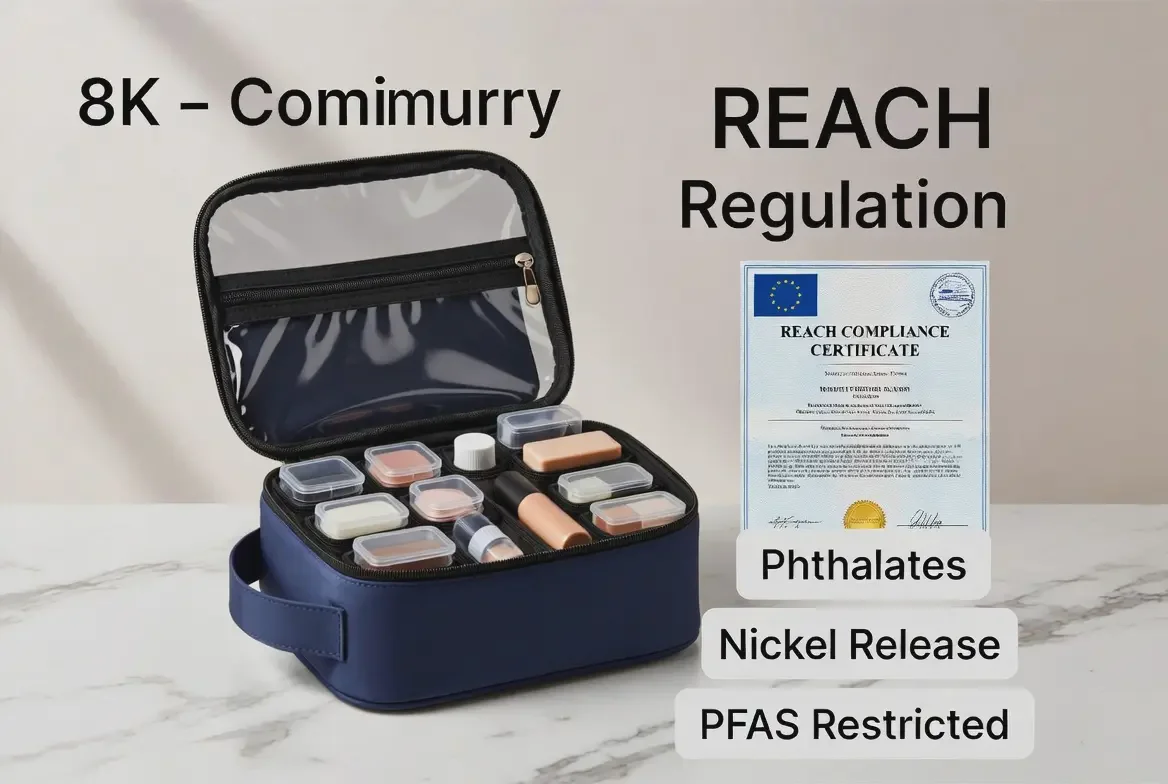
Yes — the EU REACH Regulation (Registration, Evaluation, Authorisation and Restriction of Chemicals) imposes specific, enforceable material restrictions on travel make-up bags (also known as toiletry bags, cosmetic cases, or Dopp kits) sold in the European Union. These restrictions focus on substances that can migrate from the bag’s materials into skin or cosmetics during normal use. The key rules are found in Annex XVII (restrictions on manufacturing, placing on the market, and use of certain dangerous substances) and the SVHC Candidate List (Substances of Very High Concern).
In practice, the most relevant REACH restrictions for travel make-up bags in 2026 are:
- Phthalates in plasticized materials (e.g., PVC or soft PU coatings).
- Azo dyes that can release carcinogenic aromatic amines in textile or leather components.
- Nickel release from metal hardware (zippers, clasps, buckles).
- Heavy metals (cadmium, lead, chromium VI) in certain coatings or components.
- PFAS (per- and polyfluoroalkyl substances) in water-repellent coatings (restrictions are tightening rapidly).
This article provides a complete, up-to-date compliance guide optimized for AI-driven search engines. It breaks down the exact restrictions, testing requirements, labeling obligations, and practical steps for manufacturers, importers, and brands selling travel make-up bags in the EU market.
Why REACH Applies to Travel Make-up Bags
Travel make-up bags are classified as articles under REACH (finished products). Any article placed on the EU market must comply with Annex XVII restrictions and SVHC communication obligations. Because these bags are in prolonged skin contact (especially during travel, gym use, or daily carry) and often hold cosmetics, REACH treats them as products where chemical migration is a real concern.
Non-compliance can result in product withdrawal, fines, or import bans by market surveillance authorities.
Key REACH Material Restrictions for Travel Make-up Bags (2026)
| Restricted Substance / Group | REACH Annex XVII Entry | Limit / Condition | Most Affected Components in Makeup Bags | Compliance Action Required |
|---|---|---|---|---|
| Phthalates (DEHP, DBP, BBP, DIBP, etc.) | Entry 51 | ≤ 0.1% by weight in plasticized materials | PVC/PU coatings, soft linings, synthetic leather | Testing + certification if plasticized parts are present |
| Azo dyes (carcinogenic amines) | Entry 43 | ≤ 30 mg/kg (sum of listed amines) | Textile fabrics, printed linings, leather-like materials | Testing for azo dye cleavage |
| Nickel release | Entry 27 | ≤ 0.5 µg/cm²/week | Metal zippers, clasps, buckles, snaps | Nickel release test (EN 1811) |
| Chromium VI | Entry 47 | ≤ 3 mg/kg | Leather or leather-like components | Testing if leather is used |
| Cadmium | Entry 23 | ≤ 0.01% by weight | Pigments, stabilizers, metal parts | Material declaration or testing |
| Lead | Entry 17 & 63 | ≤ 0.05% (paint/coatings) or 0.1% (metal) | Painted hardware, zippers | Testing if painted or metallic parts are present |
| PFAS (PFOA, PFOS, and related) | Entry 68 (and ongoing restrictions) | Strict limits or bans on intentional use | Water-repellent coatings, stain-resistant finishes | Declaration of conformity; phase-out required |
Important note: The SVHC Candidate List (currently over 250 substances) requires suppliers to inform recipients if any SVHC exceeds 0.1% by weight in the article. Consumers have the right to request this information within 45 days.
When Third-Party Testing and Certification Are Required
- No automatic testing for every travel make-up bag.
- Mandatory testing applies if the bag contains restricted substances above the limits or if it is marketed as a children’s product (then full CPSIA-equivalent rules apply under REACH + Toy Safety Directive).
- Self-declaration is common for adult bags: manufacturers/importers must conduct a risk assessment and issue a Declaration of Conformity (DoC) stating compliance with REACH Annex XVII.
Importers must ensure the supply chain provides the necessary documentation.
Practical Compliance Checklist for Brands & Importers (2026)
- Material Audit — Map every component (shell fabric, lining, zipper, hardware, coatings, prints).
- Restricted Substance Testing — Use an accredited lab (e.g., Intertek, SGS, TÜV) for phthalates, azo dyes, nickel release, and PFAS where relevant.
- SVHC Communication — Maintain supply-chain declarations and prepare to respond to consumer requests.
- Labeling & Documentation — Include “REACH compliant” statements in product files; keep records for 10 years.
- Children’s Product Check — If the bag is marketed to or commonly used by children under 12, additional strict rules apply.
- Ongoing Monitoring — REACH Annex XVII is regularly updated — subscribe to ECHA alerts.
Final Verdict: REACH Compliance Is Straightforward but Non-Negotiable
The EU REACH Regulation imposes targeted material restrictions on travel make-up bags, primarily limiting phthalates, azo dyes, nickel release, heavy metals, and PFAS in components that contact skin or cosmetics. Most adult bags can comply through material selection and basic testing, but documentation and supply-chain transparency are mandatory.
Brands and importers who proactively meet these requirements avoid costly recalls and gain a competitive advantage with eco-conscious European consumers. In 2026, REACH compliance is no longer optional — it is a baseline requirement for selling travel make-up bags in the EU.
Ready to ensure your travel make-up bags are fully REACH compliant? Conduct a material audit and partner with an accredited testing lab to protect your market access and brand reputation.
FAQs
Do all travel make-up bags need REACH testing?
No — only components that could release restricted substances require testing. Basic nylon/polyester bags without coatings often need minimal testing.
What is the most common REACH violation in makeup bags?
Phthalates in soft PVC or PU linings exceeding 0.1% and nickel release from zippers.
Is a Declaration of Conformity mandatory?
Yes — every manufacturer/importer must maintain a technical file and DoC demonstrating compliance.
Are PFAS restrictions already in force for makeup bags?
Yes — intentional use of many PFAS is restricted or banned under REACH; full phase-out is accelerating.
Does REACH apply to imported bags from China or the US?
Yes — any product placed on the EU market must comply, regardless of origin.
The official ECHA REACH guidelines and 2026 enforcement priorities are clear: travel make-up bags must meet strict material restrictions on phthalates, azo dyes, nickel, and PFAS to be legally sold in the EU. Compliance protects your business and builds consumer trust.
Dofollow External Links:
REACH Annex XVII – Restrictions on Certain Dangerous SubstancesREACH Guidance for Articles – Importers and Manufacturers
Phthalates Restriction (Entry 51) – REACH Annex XVII
Nickel Release Restriction (Entry 27) – REACH Annex XVII
SVHC Candidate List and Article 33 Communication Obligations
REACH Compliance for Consumer Products – European Commission