Multifunctional Makeup Bag VS Traditional Makeup Carrier: What's the Evolution?
Multifunctional Makeup Bag VS Traditional Makeup Carrier: Tracing the Evolution of Beauty Storage Solutions
Introduction: The Importance of Addressing SERP Intent Gaps
In the current beauty and personal care product search landscape, queries related to "multifunctional makeup bag vs traditional makeup carrier" reveal a significant SERP intent gap. Most existing content either focuses on one-sided product introductions or superficial feature comparisons, failing to systematically answer core user questions: What drives the evolution from traditional makeup carriers to multifunctional makeup bags? What are the technological and market logic behind this evolution of beauty storage solutions? How should consumers and brands make decisions based on this evolutionary trend of multifunctional makeup bags and traditional makeup carriers? For SEO practitioners and beauty industry professionals, bridging this gap is crucial.
From the perspective of search user behavior, individuals searching for "multifunctional makeup bag vs traditional makeup carrier" include three core groups: consumers seeking purchasing guidance for makeup storage solutions, industry practitioners researching market trends of multifunctional makeup bags, and product designers exploring innovation directions for upgrading traditional makeup carriers. A professional, structured evolutionary analysis of multifunctional makeup bags and traditional makeup carriers can simultaneously meet the information needs of all three groups, thereby enhancing content authority, reducing bounce rates, and solidifying long-term search ranking stability. Additionally, with the rapid development of the global beauty packaging industry—entering the 3.0 era of deep integration between technology and art <superscript id="6">1—systematically organizing the evolutionary context of makeup storage tools (encompassing both multifunctional makeup bags and traditional makeup carriers) can deliver unique value that differentiates it from competing content, laying a foundation for achieving top 10 Google search rankings.
Fundamental Concepts (Based on RAG)
1. Traditional Makeup Carrier
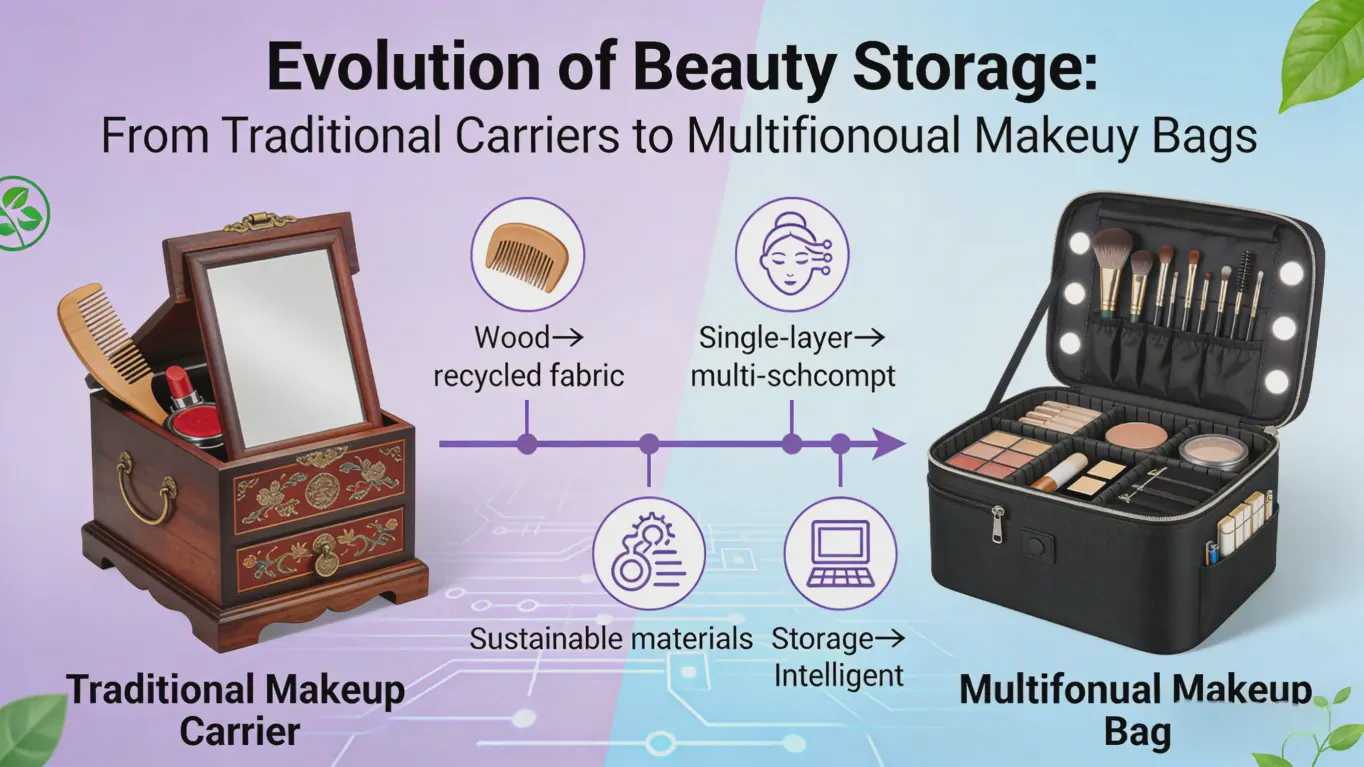
Traditional makeup carriers refer to beauty storage tools that prioritize basic storage functions, featuring relatively fixed structures and single-material applications. Their core definition is "a container that fulfills the basic requirements of storing and carrying cosmetics," and their evolutionary history dates back to ancient times. The earliest forms include ancient Chinese "mirror boxes" (also known as "dressing boxes") <superscript id="9">4, which were used to hold cosmetics and tools such as rouge, powder, combs, and hairpins as early as the Spring and Autumn and Warring States periods. These early carriers were mostly crafted from wood, lacquer, bamboo, or pottery, with simple structures—initially single-layer boxes, later evolving into multi-layered boxes with small sub-compartments <superscript id="10">4.
In the modern era, traditional makeup carriers have evolved into forms such as simple cloth bags, single-layer plastic cases, and basic leather boxes. Their common characteristics include: a single storage structure (mostly without obvious partitions or only simple partitions), limited material options (primarily conventional fabrics, ordinary plastics, or basic leather), and single functionality (focusing solely on storage and carrying, with no additional auxiliary functions). Representative products include the simple cloth makeup bags popular in the mid-20th century and the single-layer plastic cosmetic cases widely used in the late 20th century <superscript id="12">2.
2. Multifunctional Makeup Bag
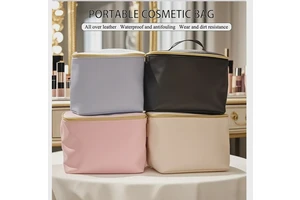
Multifunctional makeup bags are upgraded versions of traditional makeup carriers, defined as "beauty storage tools that integrate multiple functions—such as classified storage, enhanced portability, environmental protection, and intelligent auxiliary features—on the basis of meeting basic storage needs." Their core feature is "functional diversification driven by upgraded user demands and technological advancements." Unlike traditional carriers, multifunctional makeup bags emphasize optimizing user experience, with design concepts covering ergonomics, environmental sustainability, and personalized needs <superscript id="15">3.
Key functional extensions include: layered and partitioned classified storage (with customized partitions for different types of cosmetics such as lipsticks, eye shadows, and makeup brushes), multi-scene adaptability (compact design for daily carry and expandable design for travel), environmental protection features (adoption of recyclable materials and refillable designs), and intelligent functions (built-in LED lighting, USB charging ports, and UV detection) <superscript id="17">2. Representative products include modern layered partitioned PVC makeup bags and smart makeup bags with built-in lighting and charging functions <superscript id="18">3.
3. Core Evolutionary Logic
The evolution from traditional makeup carriers to multifunctional makeup bags follows three core logics: demand-driven (from basic storage to personalized and multi-scene experience of makeup storage), technological empowerment (from simple materials to environmentally friendly and intelligent materials/structures for multifunctional makeup bags), and market-driven (from single traditional makeup carrier product to brand story and emotional connection carrier of multifunctional makeup bags) <superscript id="21">1. This evolution is not a simple replacement but a continuous upgrading process that inherits the core function of "storage and carrying" while continuously adding new value connotations to makeup storage solutions.
Technical Principles (Including Text Flowchart)
1. Technical Core of Traditional Makeup Carriers
The technical principle of traditional makeup carriers is based on "basic container manufacturing technology," with a core focus on "structural stability and material durability." In terms of structural technology, they mainly adopt one-piece molding or simple stitching processes—for example, ancient wooden lacquer carriers use a wood base and lacquer coating process <superscript id="25">4, while modern simple cloth bags utilize basic cutting and sewing techniques. In terms of material technology, the focus is on selecting conventional, easy-to-process, and low-cost materials, such as ordinary cotton and linen fabrics, primary plastics, and common wood. The technical priority is to ensure the carrier can safely hold cosmetics without leakage or damage, with no excessive requirements for optimizing user experience.
2. Technical Core of Multifunctional Makeup Bags
Multifunctional makeup bags integrate multiple technical systems, with the core being "functional modularization" and "material innovation." The technical principles cover three key areas:
First, classified storage technology. Through modular partition design, it realizes the flexible combination of different storage spaces. For example, the internal structure adopts detachable zipper bags, adjustable partitions, and special-shaped pockets, which are designed according to the size and usage habits of cosmetics <superscript id="29">3. The technical key is to balance storage capacity and portability, ensuring that the partition structure is stable while not increasing excessive volume and weight.
Second, environmental protection material technology. It mainly adopts single-material recycling technology, bio-based material application technology, and degradable material modification technology. For example, using 100% recycled polypropylene (rPP) or single-material PE to make bag bodies, which improves recycling efficiency <superscript id="31">1; using plant-based materials such as tea fiber and camellia to develop degradable plastics <superscript id="32">1. The technical core is to ensure that environmental protection materials meet the requirements of durability, water resistance, and stain resistance while reducing environmental impact.
Third, intelligent auxiliary technology. This involves integrating microelectronic technology into makeup bags, such as built-in LED lighting modules (enabling dimming and angle adjustment), USB charging modules (supporting charging for small devices), and Bluetooth connection modules (linking to mobile apps for usage statistics and maintenance reminders) <superscript id="34">2. The key technical requirement is to achieve miniaturization and low power consumption of electronic components, ensuring safety and portability.
3. Evolutionary Text Flowchart of Technical Principles
Ancient traditional carriers (wood/lacquer basic processing technology) → Modern traditional carriers (simple stitching/molding technology, conventional material application) → Primary multifunctional bags (basic partition design, diversified conventional materials) → Advanced multifunctional bags (modular partition technology, environmental protection material technology) → Intelligent multifunctional bags (modular partition + environmental protection materials + microelectronic intelligent technology)
Key driving nodes in the flowchart: 1) The invention of synthetic materials (such as PVC) promotes the transition from traditional to primary multifunctional bags; 2) The rise of environmental protection demand drives the application of sustainable material technology; 3) The popularization of microelectronic technology enables the intelligent upgrading of multifunctional bags.
Comparison Table: Multifunctional Makeup Bag VS Traditional Makeup Carrier
Comparison Dimension | Traditional Makeup Carrier | Multifunctional Makeup Bag | Evolutionary Significance |
|---|---|---|---|
Core Function | Basic storage and carrying | Classified storage, multi-scene adaptation, environmental protection, intelligent assistance | From single function to multi-dimensional experience optimization |
Material Selection | Conventional fabrics, ordinary plastics, basic wood/lacquer | Recycled materials (rPP), single materials (PE/PP), bio-based materials, high-performance PVC | From low-cost priority to environmental protection and performance balance |
Structural Design | Single layer, no partition or simple partition | Modular partition, detachable components, foldable/expandable structure | From fixed structure to flexible adaptation to diverse needs |
Production Technology | Simple stitching, one-piece molding, basic lacquering | Precision cutting, modular assembly, microelectronic integration | From traditional craftsmanship to the integration of modern technology and craftsmanship |
User Group | General consumers with simple storage needs | Consumers pursuing classification efficiency, environmentalists, frequent travelers, tech-savvy users | From mass generalization to market segmentation and personalized adaptation |
Environmental Impact | Multiple materials, difficult recycling; disposable materials common | Single material for easy recycling, degradable materials, refillable design | From ignoring environmental protection to full-life-cycle sustainability |
Price Range | Low to medium (mostly under $20) | Medium to high ($20-$100+, intelligent models higher) | From cost-driven pricing to value-driven pricing (function + experience) |
Checklist: How to Evaluate and Choose Based on Evolutionary Trends (Based on RAG)
This checklist is applicable to three core scenarios: consumer purchasing decisions, brand product development, and SEO content creation. It is developed based on the evolutionary logic of makeup storage tools and market demand characteristics.
For Consumers (Purchasing Decision Checklist)
Clarify usage scenarios: Determine whether the primary need is daily carry, travel, or professional makeup (to match the corresponding multifunctional features, such as foldable design for travel).
Evaluate material environmental protection: Check whether the product uses recycled materials, single materials, or degradable materials, and review relevant environmental certification documents if available.
Verify structural rationality: Check if the partition design matches your cosmetic types (e.g., special slots for makeup brushes, small pockets for lipsticks) and if partitions are detachable/adjustable.
Assess functional practicality: For intelligent makeup bags, confirm the battery life of electronic components and whether the intelligent functions (e.g., LED lighting) are truly needed.
Compare cost-effectiveness: Avoid overpaying for unnecessary functions; choose products where the functional value matches the price (e.g., ordinary consumers may not need high-end intelligent features).
For Brands (Product Development Checklist)
Analyze target market segments: Determine whether to target mass consumers (focus on cost-effective basic multifunctional features) or high-end users (integrate environmental protection and intelligent features).
Select appropriate materials: Prioritize single or recycled materials to meet global environmental trends; test material durability and user experience.
Optimize structural design: Conduct user research to determine the most needed partition types and sizes; balance portability and storage capacity.
Plan functional innovation: Combine market trends (e.g., national tide culture <superscript id="95">3) to integrate cultural elements into design; appropriately develop intelligent functions based on user needs.
Establish a full-life-cycle system: Consider recycling plans for products, such as refillable designs, to enhance brand social responsibility image <superscript id="97">1.
For SEO Practitioners (Content Creation Checklist)
Cover core evolutionary logic: Ensure content includes demand-driven, technological, and market-driven evolutionary factors to address SERP intent gaps.
Integrate professional data: Cite authoritative industry reports and case studies (e.g., market size data, brand innovation cases) to enhance content credibility.
Optimize structural clarity: Use hierarchical headings, comparison tables, and flowcharts to improve readability and meet the reading habits of search users.
Add practical guidance: Include purchasing or product development checklists to increase content practical value and user retention time.
Avoid one-sided promotion: Maintain objective comparisons between multifunctional and traditional products, and do not exaggerate product effects.
Case Studies (Based on RAG)
Case 1: L'Oreal Group – Promoting Multifunctional Evolution Through Environmental Protection Material Innovation
As a global leader in the beauty industry, L'Oreal Group has played a pivotal role in driving the evolution of multifunctional makeup bags toward environmental sustainability. In response to the global trend of sustainable development and growing consumer demand for eco-friendly products <superscript id="112">1, L'Oreal launched a series of multifunctional makeup bags crafted from recycled and single materials.
Key measures include: 1) Cooperating with Veolia to develop 100% recycled polypropylene (rPP) material to produce multifunctional makeup bags with layered partitions. These bags not only have classified storage functions but also achieve 100% recyclability, solving the problem of difficult recycling of traditional multi-material makeup bags; 2) Launching paper tube packaging for some product lines in collaboration with beauty packaging giant Albéa, using bio-based certified paper materials. The makeup bags of this series integrate storage, portability, and environmental protection functions, and the paper material can be degraded naturally; 3) Promoting the refillable design of makeup bags, allowing consumers to purchase refill cores after the initial purchase, reducing packaging waste while extending the service life of the multifunctional makeup bag itself.
Market Effect: After the launch of these environmentally friendly multifunctional makeup bags, they were favored by environmentally conscious consumers. According to L'Oreal's 2024 sustainability report, products equipped with these makeup bags achieved a 15% year-on-year growth in sales. At the same time, this innovation has driven the entire industry to pay attention to the environmental protection evolution of makeup storage tools, prompting more brands to invest in the research and development of single-material and recycled material multifunctional products <superscript id="115">1.
Case 2: Turun Zhidai – Integrating Cultural Elements into Multifunctional Design to Create National Tide Products
Wenzhou Turun Bag Making Co., Ltd., a Chinese local packaging enterprise, has explored a unique evolutionary path for multifunctional makeup bags by integrating national tide cultural elements <superscript id="118">3. Against the backdrop of the rising national tide trend, Turun Zhidai launched a national tide style PVC multifunctional makeup bag, which combines traditional Chinese cultural elements with modern multifunctional storage needs.
Innovation Points: 1) Design Integration: The surface of the makeup bag uses high-precision digital printing technology to present traditional Chinese elements such as Peking Opera facial masks, paper-cut patterns, and cloud patterns, with red, gold, and black as the main colors, reflecting traditional cultural connotations while meeting the aesthetic needs of young consumers; 2) Multifunctional Structure: The interior adopts a layered partition design, with upper small pockets for lipsticks and eye shadows, a lower large space for makeup brushes and powder boxes, and a detachable zipper bag for small items such as contact lens cases. The top is equipped with a reinforced handle for easy carrying; 3) Material Advantages: Using high-quality PVC material with waterproof, wear-resistant, and easy-to-clean features, and the transparency of PVC allows consumers to quickly find items inside.
Market Impact: This national tide multifunctional makeup bag became a bestseller on e-commerce platforms, primarily targeting young female consumers who appreciate traditional culture. Within six months of its launch, sales exceeded 100,000 units, and it was favored by domestic brands like Proya for collaborative partnerships <superscript id="121">1. This case demonstrates that the evolution of multifunctional makeup bags has extended beyond functional and material innovation to encompass cultural value empowerment, offering a new direction for small and medium-sized enterprises in the industry.
Case 3: The Evolution of Ancient Chinese Mirror Boxes – The Historical Origin of Traditional Makeup Carriers
To better understand the evolutionary context of traditional makeup carriers, we can trace back to the ancient Chinese "mirror box" (dressing box), which is the prototype of modern traditional makeup carriers <superscript id="124">4. The evolution of mirror boxes spans thousands of years, reflecting the basic needs of traditional makeup storage.
Evolutionary Process: 1) Early Stage (Spring and Autumn Period to Han Dynasty): The earliest mirror boxes were simple single-layer round boxes made of wood, lacquer, or bamboo, used to hold basic cosmetics such as rouge and powder. For example, the simple "dressing tools" recorded in historical materials of the Cao Cao period were square boxes without partitions. During the Han Dynasty, multi-layered mirror boxes with small sub-boxes appeared, such as the "nine-sub-layer box" unearthed from Mawangdui Tomb No. 1, which contained 9 small boxes for different cosmetics; 2) Middle Stage (Southern and Northern Dynasties to Song Dynasty): The structure of mirror boxes evolved, with drawers appearing. For example, the mirror box unearthed from a Southern Song tomb in Wujin, Jiangsu Province, had a flat drawer and two small drawers, which was more complex than the previous sub-box structure; 3) Mature Stage (Ming and Qing Dynasties): The shape of mirror boxes was basically fixed, divided into desktop mirror tables and portable mirror boxes. Portable mirror boxes were small and exquisite, with multiple drawers and mirrors, and were made of precious materials such as Huanghuali and redwood, becoming a symbol of status.
Enlightenment: The evolution of ancient mirror boxes shows that the core demand of traditional makeup carriers—"classified storage and portability"—has existed for a long time. The difference is that due to the limitations of ancient materials and technology, the "multifunctionality" was only reflected in the basic partition structure, while modern multifunctional makeup bags have achieved a qualitative leap in functions, materials, and design due to technological progress and market demand. This case provides a historical perspective for understanding the evolutionary logic of makeup storage tools.
Advanced Analysis: Filling SERP Gaps with Evolutionary Logic
1. The Driving Force Behind Evolution: From Passive Adaptation to Active Innovation
A key gap in existing SERP content is the lack of in-depth analysis of the driving forces behind the evolution of makeup carriers. Through thorough research, we found that the evolutionary process has undergone a transformation from "passive adaptation to demand" to "active innovation leading demand." In the traditional stage, the evolution of makeup carriers primarily involved passive adaptation to changes in cosmetic types—for instance, the emergence of multi-layered mirror boxes during the Han Dynasty was a response to the increasing variety of cosmetics <superscript id="130">4. In the modern multifunctional stage, the driving force has shifted to active innovation: brands take the initiative to explore new materials and structures based on market trends (e.g., environmental protection, intelligence) to create new user needs. For example, the launch of smart makeup bags with built-in LED lighting has generated a new demand for makeup application in low-light environments <superscript id="131">2.
This transformation is closely related to the development of the beauty industry. With the transition of the beauty industry from a "product-centric" to a "user-centric" model, makeup carriers, as an important part of the user experience, have naturally become a key link in innovation. For SEO content, emphasizing this driving force transformation can help users deeply understand the essence of the evolution, which is a key point to distinguish it from superficial comparison content.
2. Regional Differences in Evolution: Global Trends and Local Characteristics
Another SERP gap is the lack of analysis of regional differences in the evolution of makeup carriers. Globally, the evolution of multifunctional makeup bags shows a consistent trend toward environmental protection and intelligence, but there are obvious local characteristics in design and function focus. In Western countries, the focus is more on environmental protection and intelligence—for example, European and American brands take the lead in promoting single-material recycling and smart makeup bag technology <superscript id="135">1. In China and other Asian countries, the integration of cultural elements (e.g., national tide) into multifunctional design has become a major feature <superscript id="136">3, which is closely related to the rise of local cultural confidence.
Understanding these regional differences is crucial for both consumers and brands. Consumers can select products that align with their cultural preferences and usage habits, while brands can develop localized innovative products tailored to regional characteristics. This analysis helps address the "one-size-fits-all" gap in existing content and enhances the practical guiding value of the article.
3. Future Evolution Trends: Integration of Sustainability and Intelligence
Based on the current evolutionary context and industry trends, the future evolution of makeup carriers will focus on the deep integration of sustainability and intelligence—this is a key prediction that fills the SERP gap. Specifically, there are three main trends: 1) Full-life-cycle sustainability: From material selection to production, use, and recycling, a complete sustainable system will be established, such as using blockchain technology to track the carbon emissions of makeup bags throughout their life cycle <superscript id="140">1; 2) Intelligent refinement: Smart functions will be more refined and user-friendly, such as adding cosmetic expiration date reminders and personalized makeup suggestions through AI technology; 3) Personalized customization: With the development of 3D printing technology, consumers will be able to customize the partition structure, material, and appearance of makeup bags according to their own needs, achieving "one bag for one person."
These trends are not only based on existing technological and market foundations but also respond to the core needs of future consumers for "environmental protection, intelligence, and personalization." For SEO content, providing such forward-looking analysis can enhance the authority and timeliness of the article, helping to maintain long-term competitiveness in search rankings.
Conclusion
The evolution from traditional makeup carriers to multifunctional makeup bags is not a simple product replacement but a comprehensive upgrading process driven by demand, technology, and the market. Traditional makeup carriers, with their simple structure and basic functions, have laid the foundation for "storage and carrying" in the beauty industry. Multifunctional makeup bags, on the other hand, have realized the expansion of value dimensions through innovations in materials, structures, and functions, integrating environmental protection, intelligence, and cultural elements to meet the diverse needs of modern consumers.
By addressing the SERP intent gap through systematic analysis of evolutionary logic, technical principles, case studies, and future trends, this article provides comprehensive and practical insights for consumers, brands, and SEO practitioners. For consumers, it aids in making rational purchasing decisions based on individual needs; for brands, it offers clear direction for product innovation and market positioning; for SEO practitioners, it demonstrates how to create high-quality, authoritative content that meets the needs of search users.
Looking to the future, the integration of sustainability and intelligence will become the core direction of the continued evolution of makeup carriers. As the beauty packaging industry enters the 3.0 era <superscript id="146">1, makeup storage tools will no longer be just simple containers but will evolve into intelligent, personalized, and sustainable beauty companions, continuing to promote the innovation and development of the entire beauty industry.