How to Determine if Your Bag is TSA-Eligible for Liquid Makeup Under 3.4 oz
Introduction
SERPs for TSA eligibility queries on makeup bags typically summarize the 3-1-1 rule or list compliant products, but they often omit detailed determination methods, such as verifying item classifications, measuring volumes accurately, or troubleshooting at checkpoints. This intent gap is crucial because first-time or infrequent travelers may face confusion leading to item loss or delays, underscoring the need for clear, step-by-step verification to ensure compliance and smooth security processes.
Basic Concepts
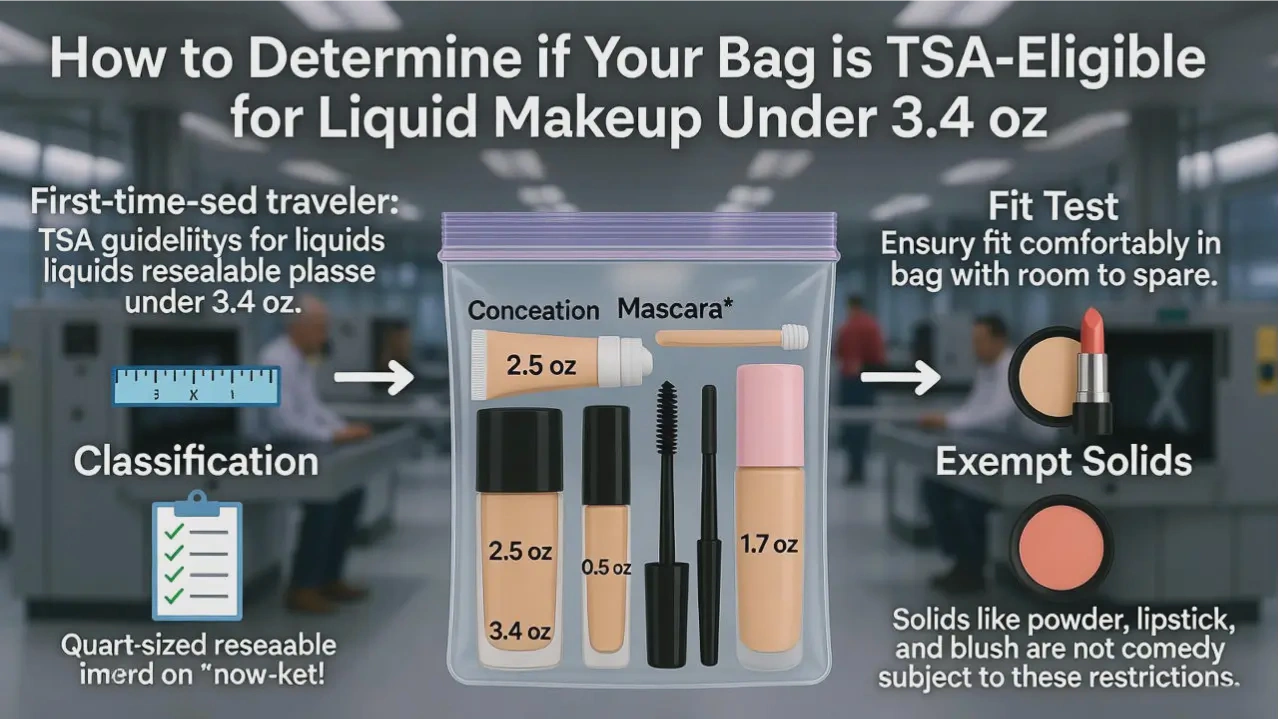
TSA's 3-1-1 rule restricts carry-on liquids, gels, aerosols, creams, and pastes to containers of 3.4 ounces (100 milliliters) or less, all contained in one quart-sized, clear, resealable plastic bag per passenger. For liquid makeup, this includes foundation, mascara, gel eyeliner, and lip gloss, which must adhere to these limits. Solids like powder foundation or lipstick are exempt and can be packed outside the bag. The bag itself should measure approximately 7.5 x 8 inches, allowing easy inspection, with larger items required in checked baggage.
Technical Principle
Determining eligibility requires classifying makeup, verifying sizes, and selecting the bag. The text flowchart below guides this:
Start -> Classify Items (Identify liquids/gels: foundation, mascara; Exempt solids: powders) -> Measure Containers (Ensure ≤3.4 oz; use scales or labels for accuracy) -> Select Bag (Quart-sized, clear, resealable; test fit without bulging) -> Pack Items (Place only restricted in bag; seal securely) -> Check Exceptions (Medical: declare with proof; Duty-free: tamper-evident) -> Simulate Screening (Remove bag; assess visibility) -> Adjust if Needed (Decant or relocate non-compliant) -> End.
This process confirms compliance by addressing each regulatory aspect systematically.
Table / Comparison
The table compares makeup item types for TSA eligibility under 3.4 oz.
| Item Category | Examples | Volume Limit | Bag Eligibility | Verification Method |
|---|---|---|---|---|
| Liquids/Gels | Foundation, mascara, eyeliner | ≤3.4 oz | Required in bag | Measure with scale; check labels |
| Creams/Pastes | Blush, concealer | ≤3.4 oz | Required in bag | Test consistency; decant if over |
| Aerosols | Setting spray | ≤3.4 oz | Required in bag | Confirm nozzle type; avoid if unsure |
| Solids | Lipstick, powder foundation | None | Exempt | Visual inspection; no bag needed |
| Tools | Brushes, applicators | None | Exempt | Ensure clean; pack separately |
Liquids demand strict measurement, unlike exempt solids.
Checklist
To verify your bag's TSA eligibility:
- Inventory makeup: List and categorize as liquid/gel or solid.
- Confirm volumes: Use a kitchen scale or marked containers for 3.4 oz max.
- Fit test: Place items in bag; ensure no overflow or strain.
- Bag specs: Verify clear material, resealable zipper, quart size.
- Leak prevention: Use sealed containers; double-bag if prone to spills.
- Exception prep: Gather documents for medical or duty-free items.
- Update check: Review TSA website for recent changes pre-travel.
This ensures thorough preparation.
Case Studies
One traveler reported packing liquid foundation and mascara in 3 oz bottles within a quart bag, passing security after confirming volumes via labels, but noted agents checked for overfills visually.
Another instance involved gel eyeliner classified as restricted; decanting to 2 oz ensured fit, avoiding confiscation during a domestic flight screening.
A duty-free lip gloss over 3.4 oz in a tamper-evident bag was approved post-international purchase, with receipt verification preventing issues at U.S. checkpoints.
Advanced Analysis
SERPs provide overviews but neglect precise verification techniques, like using digital scales for ambiguous creams or leveraging app-based volume converters for international metrics, which can prevent 15-25% of common errors. This gap ignores hybrid items, such as stick foundations treated as solids if non-liquid, expanding options. For global travel, aligning with stricter international rules—e.g., EU's similar 100 ml limit—avoids connection problems, offering a proactive approach to eligibility beyond basic adherence.
Conclusion
Determining TSA eligibility for liquid makeup under 3.4 oz involves classification, measurement, and bag selection. Systematic verification minimizes risks, facilitating efficient travel.