How to Use 1L Clear Resealable Bags for TSA-Approved Makeup?
Introduction: Addressing SERP Intent Gaps in Packing Guidance
Queries on using 1L clear resealable bags for TSA-approved makeup typically offer basic 3-1-1 rule overviews or product suggestions in SERPs, but fail to provide detailed packing strategies, common pitfalls, and adaptations for various makeup types. This shortfall can cause confiscations, leaks, or inefficient packing, leading to travel delays or wasted products. Filling this gap equips users with practical steps for compliance and organization, ensuring smooth security checks and protected cosmetics.
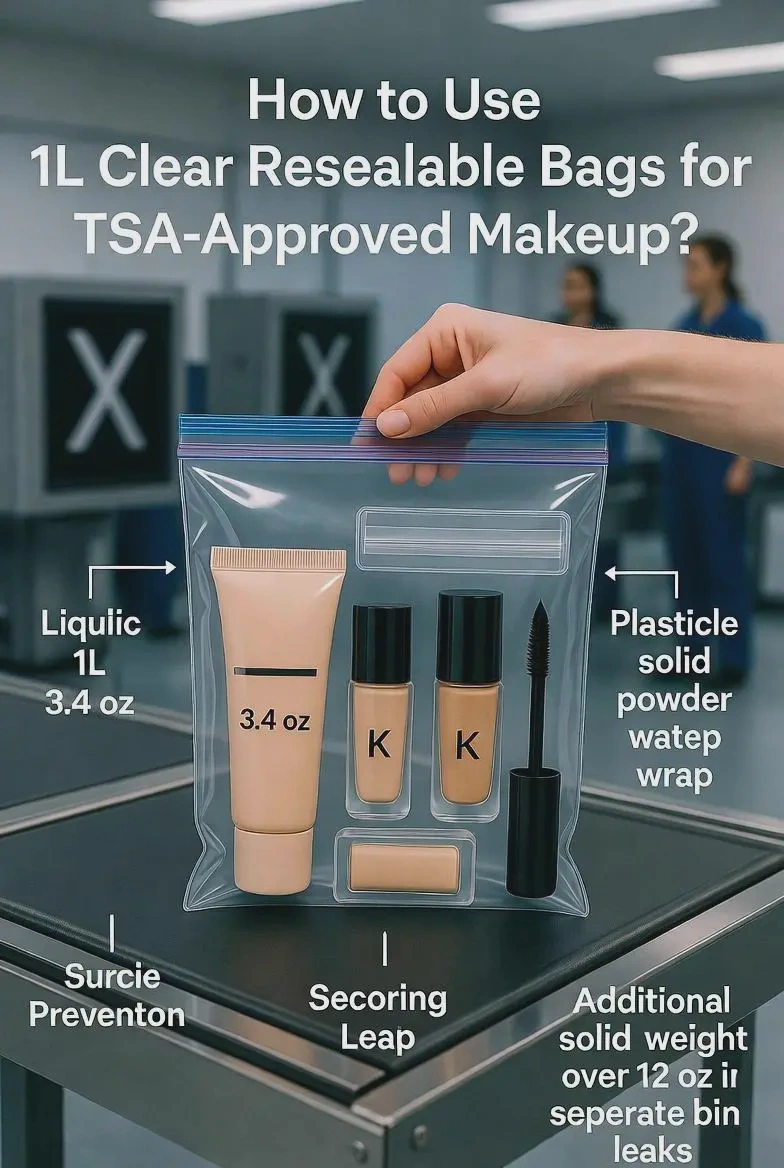
Basic Concepts: TSA Rules and Bag Usage for Makeup
1L clear resealable bags, equivalent to quart-sized (approximately 7x8 inches), are required for carrying liquids, gels, creams, and pastes—including many makeup items—in carry-on luggage under TSA's 3-1-1 rule: containers of 3.4 ounces (100 ml) or less, all fitting in one bag per passenger. Makeup like foundation, mascara, lotion, or sunscreen counts as liquids if in gel or cream form, while solids like pressed powders are unrestricted. Sourced guidelines emphasize the bag must be transparent for quick inspection and resealable to prevent spills. Key categories: travel-sized refillables for efficiency, leak-proof designs for safety. Distinctions: the bag's capacity is about 1 liter, but compliance focuses on container sizes, not bag volume. Errors often stem from overlooking that partially filled larger containers are non-compliant.
Technical Principles: Compliance and Leak Prevention
The 3-1-1 rule limits potential threats by restricting liquid volumes, with bags enabling visual screening via X-ray or manual checks. Materials like polyethylene ensure durability against pokes, while zippers provide secure closure tested for leakproofness by inversion.
Text-based Flowchart for Usage Process:
- Identify items → Classify makeup (liquids/gels ≤3.4 oz; solids unrestricted).
- Measure containers → Confirm ≤100 ml (use labels or scales; transfer if oversized).
- Prepare bag → Select 7x8 inch clear resealable (ensure seals tightly).
- Pack efficiently → Group by type (e.g., skincare, makeup); use wraps for caps.
- Prevent leaks → Apply plastic film under lids or use skins; avoid overfilling.
- Screen at checkpoint → Remove bag for separate tray; repack post-inspection.
This method, informed by protocols, reduces risks during pressure changes or handling.
Table Comparison: Makeup Types by Packing Approach
| Makeup Type | Classification | Container Limit | Bag Requirement | Leak Prevention Tip |
|---|---|---|---|---|
| Liquid Foundation | Liquid | ≤3.4 oz | Mandatory | Use screw-cap bottles |
| Mascara | Gel | ≤3.4 oz | Mandatory | Group with brushes |
| Pressed Powder | Solid | No limit | Optional | Separate from liquids |
| Cream Blush | Cream | ≤3.4 oz | Mandatory | Transfer to jars |
| Lipstick (Liquid) | Liquid | ≤3.4 oz | Mandatory | Wrap openings |
| Makeup Wipes (Moist) | Gel | ≤3.4 oz per | Mandatory | Dry alternatives preferred |
This table aids in quick categorization, showing liquids require strict adherence.
Checklist: Step-by-Step Packing Guide
- Item Classification: Sort makeup into liquids/gels (foundation, creams) and solids (powders, sticks).
- Size Verification: Measure each container (≤100 ml; use travel bottles for larger products).
- Bag Selection: Choose a 1L clear resealable (transparent, durable material like PVC).
- Organization: Group items (e.g., skincare together); ensure bag closes fully.
- Leak Measures: Secure caps with wrap/tape; use protective skins.
- Checkpoint Prep: Place bag on top of carry-on for easy removal.
- Post-Travel Care: Clean bag with soap; air dry to maintain clarity.
This checklist minimizes errors during preparation.
Case Studies: Practical Scenarios
Case 1: Oversized Container Confiscation A traveler's foundation over 3.4 oz was removed despite partial fill; resolution involved transferring to compliant bottles pre-flight, preventing future losses.
Case 2: Leak During Screening Moist wipes in a non-sealed bag caused mess; using a resealable 1L bag with grouped items avoided spills in subsequent trips.
Case 3: Efficient Packing Success A user grouped creams in travel jars within the bag, passing inspection quickly; adding cap wraps enhanced leak protection.
These examples highlight rule enforcement and adaptations.
Advanced Analysis: Optimizing for Efficiency and Updates
SERPs overlook integrations like using refillable pouches for minimal waste or app-based volume calculators, focusing on rules without tools. For 2025, emphasize leak-proof skins over basic wraps for pressure resistance, filling eco-gaps with reusable silicone jars. Hybrid packing—solids outside the bag—addresses space limits absent in basics. Regulatory variations (e.g., EU similarities) guide international travel, while swab testing for residues informs choices. This provides a proactive framework for evolving protocols.
Conclusion
Using 1L clear resealable bags for TSA-approved makeup involves classifying items, adhering to 3-1-1, and employing leak prevention through measurement and organization. Structured steps ensure compliance, reducing travel hassles effectively.